An interview with Nina Munteanu – Gaia’s Revolution
Screenshot
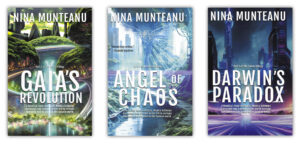
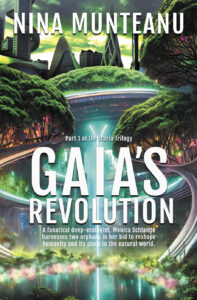
My guest today is Nina Munteanu, Canadian author, essayist, and blogger. Nina has published over a dozen fiction and non-fiction books, mostly on the environment. She does a column on Reality Skimming Press and blogs about the environment on her site The Meaning of Water. Today, we’ll be discussing her just-released ecological thriller, Gaia’s Revolution, Book 1 of The Icaria Trilogy, put out by Dragon Moon Press in Calgary.
So, what’s the trilogy about?
It’s a bit of a saga that starts in Berlin in 2022 (Book 1, Gaia’s Revolution) and moves to the Toronto area in Canada, through several generations over seven decades (Books 2 and 3). The trilogy explores a collapsing capitalist society in Canada through ravages of climate change and a failing technology. Book 1 starts with ambitious twin brothers Eric, a gifted engineer, and Damien Vogel, a brilliant scientist, who escape the growing racial violence of Berlin, to ‘peaceful’ Canada in a rivalry to control the evolution of the human race. The warring brothers set off a violent revolution that destroys the Canadian technocratic government and whose weapons ultimately risk the survival of humanity. Fanatical deep ecologist Monica Schlange snares both brothers in her gambit to reshape humanity and its place in the natural world. Three orphaned children, caught in the web of intrigue and violence, will ultimately determine the direction of humanity by introducing the first veemelds (people who can communicate with machines), a new environmental disease, and a new set of rules neither brother envisioned.
By 2095 (Book 2, Angel of Chaos and Book 3, Darwin’s Paradox), humanity—now under Gaian rule—has fled inside environmental dome cities called Icarias, chased inside by an unruly environment. Icarians struggle with Darwin’s Disease—a mysterious neurological environmental pandemic. Icaria 5 (formerly Toronto, Canada) is one of many enclosed cities within the slowly recovering toxic wasteland of North America, and where the protagonist Julie Crane (daughter of one of the orphans in Gaia’s Revolution and a veemeld) lives and works. Julie must deal with the ghosts of the characters in Book 1: including her dead and discredited father, now implicated in spreading subversive science and charged with several political assassinations.
A technocratic government in Canada? How did you envision that?
My premise involves several key climate disasters coupled with a highly unpopular decision by the Liberal government to welcome millions of climate refugees, providing housing and amenities that disaster-affected Canadians did not get. This scenario and accompanying sentiment is not new. In 2015, Angela Merkel welcomed over a million refugees from Iraq and Syria into Germany; public support quickly waned and the far right exploited rejection of the policy. Continuing with my premise, increased unrest grew in Canada as protests mobilized the far-right and gave voice to Christian fundamentalists, white supremacists, anti-Semitic conspiracy theorists and Islamophobic nationalists. The growing rift between the polarized major parties opened a gap filled by a new party, neither far right nor far left and based on the logic and merit of science & technology: the Technocratic Party of Canada. The party skyrocketed in popularity with an intelligent population who were fed up with political sophistry and empty rhetoric and excuses. The Technocrats had a plan that made sense and they demonstrated the expertise to carry it out: ways to successfully adapt to climate change, using technology and scientific research. The party subscribed to a scientific management approach, a Taylorism approach based on four principles: select methods based on science; assign jobs based on aptitude; monitor performance; and divide workload based on a systems approach. But, as you read above, they, too, are overthrown for something else: the Gaian dynasty of deep ecologists.
You’ve brought in many characters in this saga. Who is your favourite?
You’ll laugh: the main antagonist of Gaia’s Revolution, Monica Schlange (and what she becomes). I really enjoyed writing about the twin brothers—contrasting them despite their twin origins. I also enjoyed writing the three orphan characters: about their terrible journey to safety when the violent revolution moved from the cities to the countryside. I also enjoyed writing Julie’s character (in Books 2 and 3), her journey as a veemeld (gifted and cursed) and being the daughter of a traitor, who must find her way in a treacherous world of lies and intrigue. But my favourite is Monica Schlange: the fanatical deep ecologist, revolutionary, shape-shifter, bad-ass warrior, villain with a conscience. She is a paradox: she cares immensely about the planet, the welfare of the planet’s ecosystems and displays compassion for the orphans; but she has no qualms about killing a man in cold blood—which she does, on several occasions.
There is a scene where twin brother Eric unleashes a techno-clone to murder a colleague of Monica’s; techno-clones are hybrid cyborgs, DNA-altered men merged with synthetics and weapons fused into them, all connected by a hive mind. Monica takes on this murder-machine and cleverly dispatches him—when no one else has been able to. This quickly earns her a reputation as a Badass warrior and soon images of her face—scar across her temple—is plastered everywhere by the revolutionaries.
Throughout the first book, I provide a few moments of perspective into Monica’s past. An only child, she grew up on one of the last independent dairy farms in Ontario—before the Technocrats seized it and converted it into a Corporation Farm using scientific agriculture. It killed her father, who she dearly loved. Her mother took to whoring with the first trucker who came along, abandoning her. A ruthless eco-terrorist and subversive, Monica is bent on destroying the capitalist-technocratic machinery to save the planet at the expense of human domination. An unscrupulous eco-terrorist, she uses sabotage and internet tampering to disrupt and hurt climate offenders. She is the quintessential anti-hero. I guess you could say that I realized some terrible fantasies through this character.
What are you currently working on?
Not much. I’m taking a wee break from novel-writing and focusing on marketing. I’m currently shopping an eco-fiction novel around that takes place in southern Ontario and the Kurpiowska Forest in Poland during the communist era (specifically the 50s to 70s). I did a lot of research for that book and it was so fascinating!
I am actively coaching writers to publication (see www.NinaMunteanu.me) and writing nature and environmental articles for various magazines and my own blogs (www.TheMeaningOfWater.com). I’m also curating a column on Lynda Williams’s Reality Skimming Press blog on sustainability. Called “Sustainability Over Ambition”, the column consists of a series of articles and interviews I’m conducting with mostly Canadian authors on that complex subject. If you’re a Canadian author, feel free to reach out to me if you’re interested in being interviewed.
Tell me a little more about your coaching services?
My coaching includes advice on all story aspects (like storyboarding, world building, character, plot, etc.). I also edit, but my service usually encompasses far more, such as narrative flow, sentence structure, meaning, clarity, and concision. I look at just about every kind of fiction, except horror. I help writers with their nonfiction such as memoirs, biographies, how-to books, and technical books. I also do technical and scientific editing of papers and reports.
Where can people buy Gaia’s Revolution and the entire trilogy?
The entire Icaria Trilogy can be purchased on Amazon and other online and brick and mortar bookstores, such as Chapters. Books 2 and 3 are also available in many libraries throughout Canada, given that they’ve been out for a while.
Thanks, Nina, for being my guest here today and the very best of luck with The Icaria Trilogy.
You can learn more about Nina and her work on her website at www.ninamunteanu.com. You can also find her on social media (Bluesky, Twitter, and LinkedIn).